AIMold: An Autonomous AI-based Pipeline
for Complex Mold Design

ECCV 2026
Pengyun Qiu1*,  Shuo Wang1*,  Zeyuan Chen1Yihao Zhi1Chongjie Ye2,1Xiaoguang Han1,2†
1SSE, CUHKSZ   2FNii, CUHKSZ
*Equal contribution  Corresponding author

Given a single-body CAD part (blue), AIMold automatically generates a complete, manufacturing-ready injection-mold assembly — auxiliary components (yellow) and upper / lower molds (cyan / brown).

Abstract

We present AIMold, an autonomous pipeline for injection-mold design of complex parts with undercuts and side holes. Given a single-body CAD model, it predicts the demolding orientation, generates auxiliary components, and derives the upper and lower molds to form a complete, manufacturing-ready assembly. We also introduce MoldCAD, the first large-scale paired part–mold dataset with over 23k engineer-designed models, on which AIMold faithfully reproduces expert-designed mold geometry.

Method

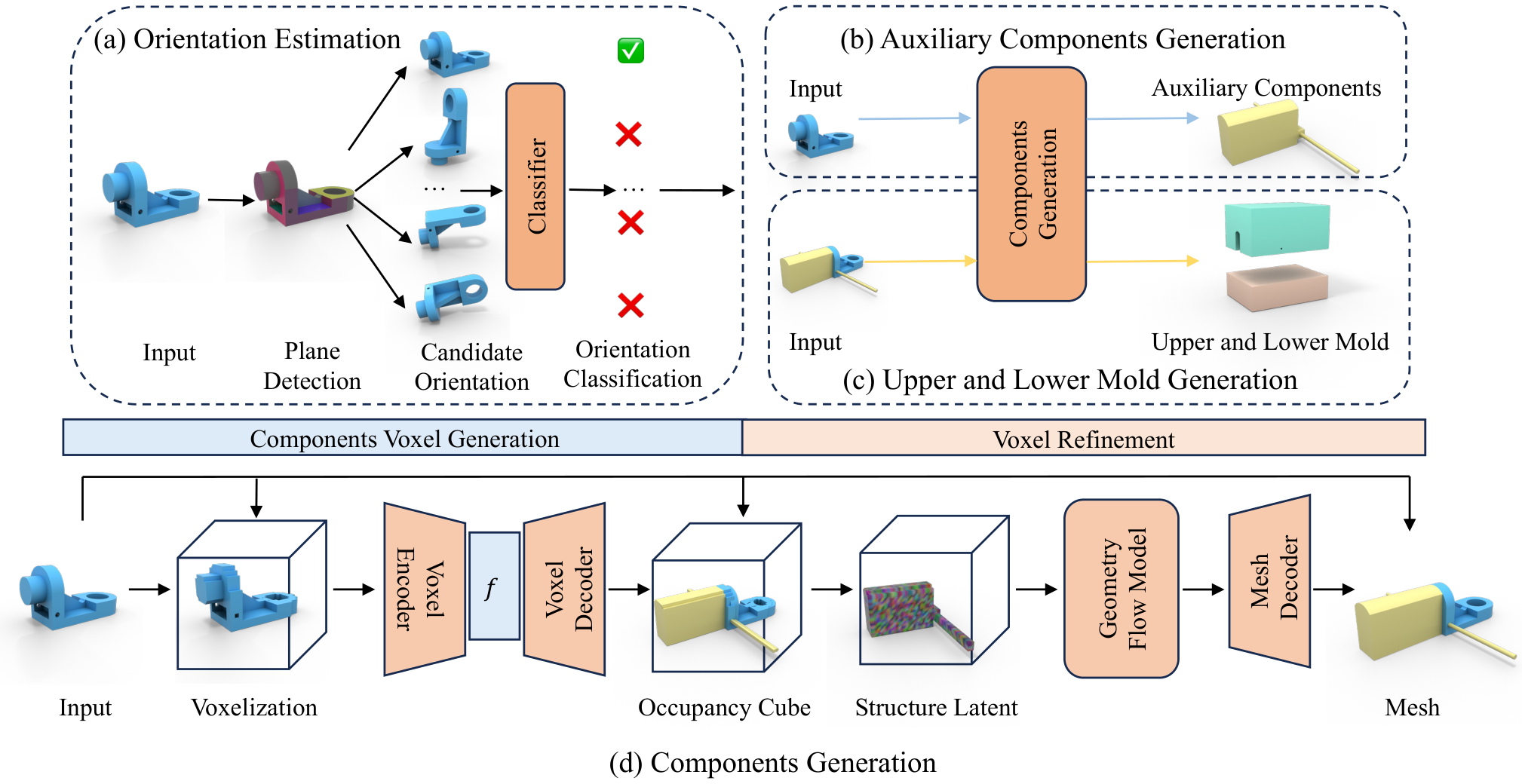
AIMold pipeline overview

AIMold decomposes mold design into three steps: estimating the demolding orientation, generating auxiliary components, and deriving the upper and lower molds. Each component is generated in two phases — coarse voxel generation followed by flow-based refinement that recovers sharp, CAD-like geometry — and the resulting assembly is exported as editable STEP files.

From a single input part to the complete generated mold assembly.

Dataset

MoldCAD is the first large-scale paired dataset of single-body parts and professionally designed injection-mold assemblies. Parts are curated from industrial CAD repositories (ABC, BRepNet) with strict manufacturing prerequisites — manifold, watertight, solid — while explicitly retaining complex undercuts and side holes. For every part, professional mold engineers author a complete assembly following standard industrial practice, annotated at the instance level.

5k+
mold assemblies
23k+
individual models
100%
engineer-designed GT
Professional mold design workflow
Professional design workflow: (a)–(c) analyze the demolding direction and localize concave regions; (d) design auxiliary components; (e) construct the parting surface.
Exploded views of MoldCAD samples: input parts (blue) with their auxiliary components (yellow).

Results

AIMold consistently outperforms latent-space baselines: the generated geometry aligns closely with the input CAD model and faithfully matches the engineer-designed ground truth, while the two-stage voxel refinement recovers evident CAD features such as sharp edges and planar faces.

Input part   Generated component
Interactive results — drag any model to rotate, scroll to zoom.

BibTeX

@article{qiu2026aimold,
  title   = {AIMold: An Autonomous AI-based Pipeline for Complex Mold Design},
  author  = {Qiu, Pengyun and Wang, Shuo and Chen, Zeyuan and Zhi, Yihao and Ye, Chongjie and Han, Xiaoguang},
  journal = {arXiv preprint arXiv:2608.00800},
  year    = {2026}
}